
At Monday’s Edgecombe County Board of Education meeting, educators and union leaders urged district leaders to honor commitments to fair representation and provide stronger support for educator advocacy.
Marcia Boyd-Williams, President of the Edgecombe County Association of Educators and a multi-classroom leader at Coker-Wimberly Elementary, addressed the board with two urgent requests.
First, she asked the district to approve her full-time professional leave, a practice already adopted in several North Carolina counties including Wake, Durham, Guilford, and Buncombe. Under this arrangement, the union covers the full cost of the local president’s salary, while local leaders dedicate their time to building educator voice and advocacy.
“Edgecombe should be proud to have been chosen for this investment,” Boyd-Williams told the board. “Why should other counties benefit from this statewide union support, but not us?”
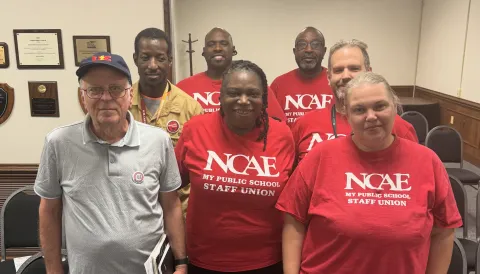
Her second concern centered on the district’s advisory policy, which she criticized as “window dressing.” The current model, where administrators handpick advisory members or limit them to Teachers of the Year, she argued, fails to provide authentic representation of school staff. Instead, Boyd-Williams called for a “meet and confer” policy, where educators elect their own representatives to discuss issues with district leaders.
“Policy made about us without us misses the reality of what happens day to day in our classrooms,” she said. “We need democracy, not window dressing, to truly serve our community.”
Boyd-Williams also placed these issues in historical context, pointing to North Carolina’s Jim Crow-era ban on collective bargaining. She argued that giving educators a voice in district decisions is one way to undo some of that harm. She closed by requesting another opportunity to present detailed information on both the full-time release and the proposed meet and confer model.
Her call was echoed by James Barnes, a veteran agriculture teacher at North Edgecombe High School with nearly 40 years in education. Barnes attended the meeting to support younger educators and to highlight what he sees as a contradiction between the board’s words and its actions.
Reflecting on the meeting’s opening Pledge of Allegiance, Barnes noted: “We ended with ‘liberty and justice for all.’ But when 400 people in our schools call for this action, and the board agrees, then fails to follow through—I have to ask, where is justice?”
Barnes urged the board to recognize union representation and to allow educators to choose their own spokesperson. “That’s all we need,” he said. “Meet and confer, and our voices heard.”
Both Boyd-Williams and Barnes stressed that giving educators a democratic role in shaping district policy is not only about fairness for staff but also about improving learning conditions for students. They urged the board to reconsider its stance, approve full-time release for local union leadership, and adopt a Meet and Confer model that ensures authentic educator representation in decision-making.