Raleigh, NC - In a newly released report, the North Carolina Association of Educators (NCAE) outlines a vision for what North Carolina’s public schools could achieve with full, sustained investment. Titled “Public Schools, Public Good: What North Carolina Can Achieve When We Fully Invest in Our Children,” the report highlights the extraordinary work taking place in public schools across the state despite chronic underinvestment.
Over the last decade, North Carolina has moved to prioritize tax cuts for corporations and private school subsidies over sustain investments into public schools.
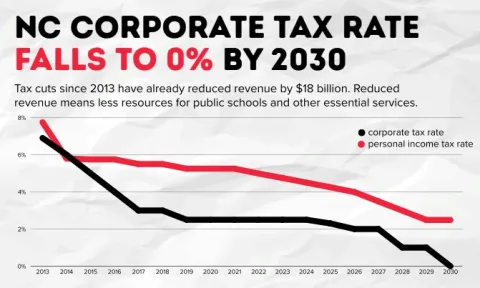
Since 2013, state leaders have enacted a series of laws that have steadily reduced personal income tax rates and has set the state on the path to eliminate the corporate income tax completely by 2030. This is despite income taxes making up more than half of North Carolina’s funding for public services, including public education. As a result of these tax policies, North Carolina is now losing nearly $18 billion in revenue annually. These policies are preventing state revenue collection to keep pace with the cost of providing high-quality public services and maintain infrastructure needed to meet North Carolina's ongoing population growth.
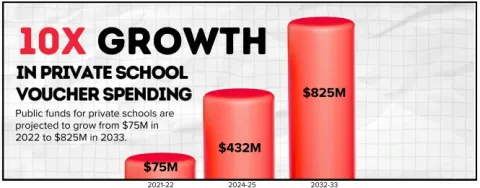
At the same time, state leaders have dramatically expanded private school vouchers through the Opportunity Scholarship Program. What was once a targeted program to help low-income families has now become an entitlement program for wealthy private school families. North Carolina spent more than $432 million on vouchers in the last school year alone, and the program is projected to cost the state more than $7 billion by 2033. These choices constrain per-student funding, suppress educator pay, and widen disparities between districts—outcomes driven not by economic necessity, but by deliberate fiscal priorities.
As a result, North Carolina consistently ranks near the bottom nationally for education funding effort, per-pupil spending, and educator pay when adjusted for inflation. These rankings translate into real consequences: students attending schools without enough counselors, limited course offerings, and aging facilities; educators managing overcrowded classrooms, inadequate planning time, and working multiple jobs just to make ends meet. These policy decisions have fueled an ongoing crisis in recruiting and retaining educators across the state.
While this is the reality facing North Carolina today, the future can look very different if the state reverses course and fully funds its public schools. Research consistently shows that sustained investments in public education lead to improved academic outcomes, higher graduation rates, and greater long-term economic mobility—especially for students from low-income backgrounds and communities of color.
With increased, predictable, and equitable funding, North Carolina’s public schools can offer smaller class sizes, competitive educator pay, and enriched learning opportunities that prepare students for life beyond the classroom. The result would be stronger communities, a more stable workforce, and a more prosperous North Carolina.
“For too long, our state leadership has starved and neglected our public schools," said Tamika Walker Kelly, NCAE President. "We know, just as our students know, our educators know, the research shows, and public opinion shows that public schools are the heart of our communities. With a proper investment in our public schools, we can ensure that our children, working class families, and our communities will have a bright future that makes North Carolina the best state in the nation.”