For the past four years, as a final project, I have had my students in Honors Earth and Environmental Science classes participate in The Eco Attachment Dance. While the “dance” part of the name has been a bit of a mystery for my students and me over the years (I have my ideas…), the “eco attachment” component is simple enough to understand – ecological attachment, i.e., nature connection.
I first heard about the Eco Attachment Dance during my first year teaching in North Carolina while reading Restoring the Kinship Worldview; in a passing sentence, one of the authors, Dr. Darcia Narvaez, mentions this set of practices that she and her graduate students at the University of Notre Dame collaborated on to improve participants' ecological awareness and ecological empathy. I was intrigued — mostly by the name, but also by what they were trying to achieve. You can read more about their findings here (Kurth et al. 2020).
Here is a basic overview of how it works: for each of 28 days, I have my students follow the guided prompt for that day, and then they write a short reflection about their experience. To keep things simple, I tell them to expect spending about 15 minutes per day practicing and then reflecting on their experience (from a logistical perspective, I do try to be mindful about this additional responsibility I have put on my students, and try to manage how much homework I assign over the course of the month). Some of the days’ prompts are straightforward, such as “Think of a favorite plant in your life and feel gratitude for its life and its gifts to you.” Others are a little more abstract, like “Acknowledge the bushes you see today. Notice how they are each unique.” While I use some class time to facilitate the practices, my students have generally preferred doing them outside of school. Many have said that they appreciate having the time to think and write in a quieter space than the classroom.
In effect, what I have been doing is creating a mechanism by which I help students spend more time outside noticing the world around them. Dr. Narvaez puts the goal of the Eco Attachment Dance clearly in her introduction to the dance:
We often go about our days not thinking too much about the animals and plants around us, even those that keep us alive. We often act mindlessly, destructively towards the natural world. We’ve known for decades that acts like these, these bad habits, would lead to the ecological crises we face today. Knowledge about our destructive ways has not helped. Do we care? It's our hearts that must change. We must care for nature in the right way, and to do that we must feel connected to it.
In framing this long-term project with my students, I tell them that we are in the midst of changing their minds as we read textbook chapters, conduct field and laboratory studies, and hold discussions in class. This project is a chance for them to change their hearts. As a scientist, I know that it is important for my students to have a firm understanding of our environment, but I also hope that they will come away from this course with a deeper connection to that environment.
In my experience, it has been incredibly effective, and not just at deepening their connection with the natural world (as shown in the figures below), but also in increasing my students’ abilities to think and reflect. This last part is informed by my informal interactions with hundreds of students over the past few years — from the daily reflections, to the creative reflective component that I have my students complete at the conclusion of the project, to their written reflection of this creative reflection that thus reflects their daily reflections. Without ever saying the word, my students are developing their metacognition.
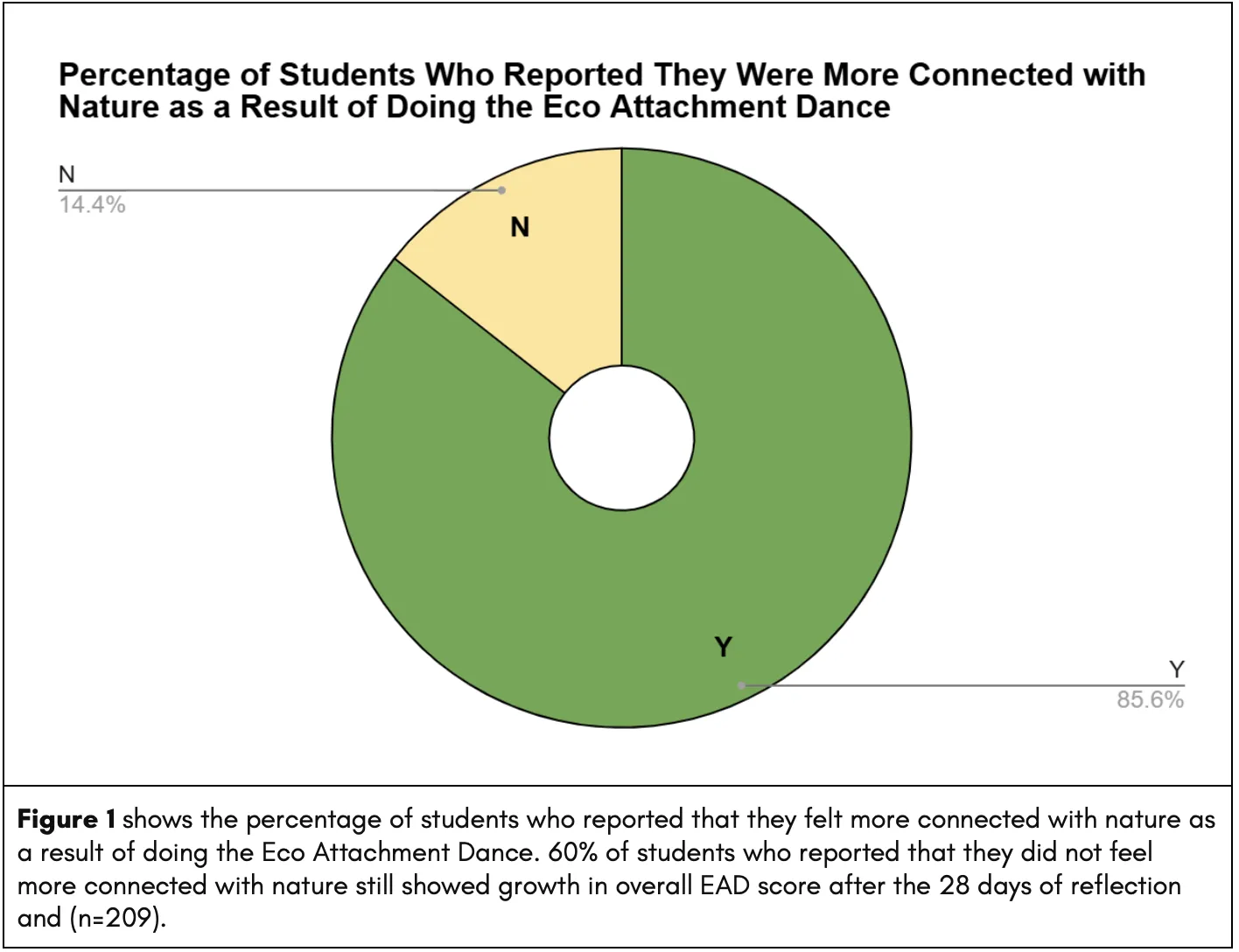
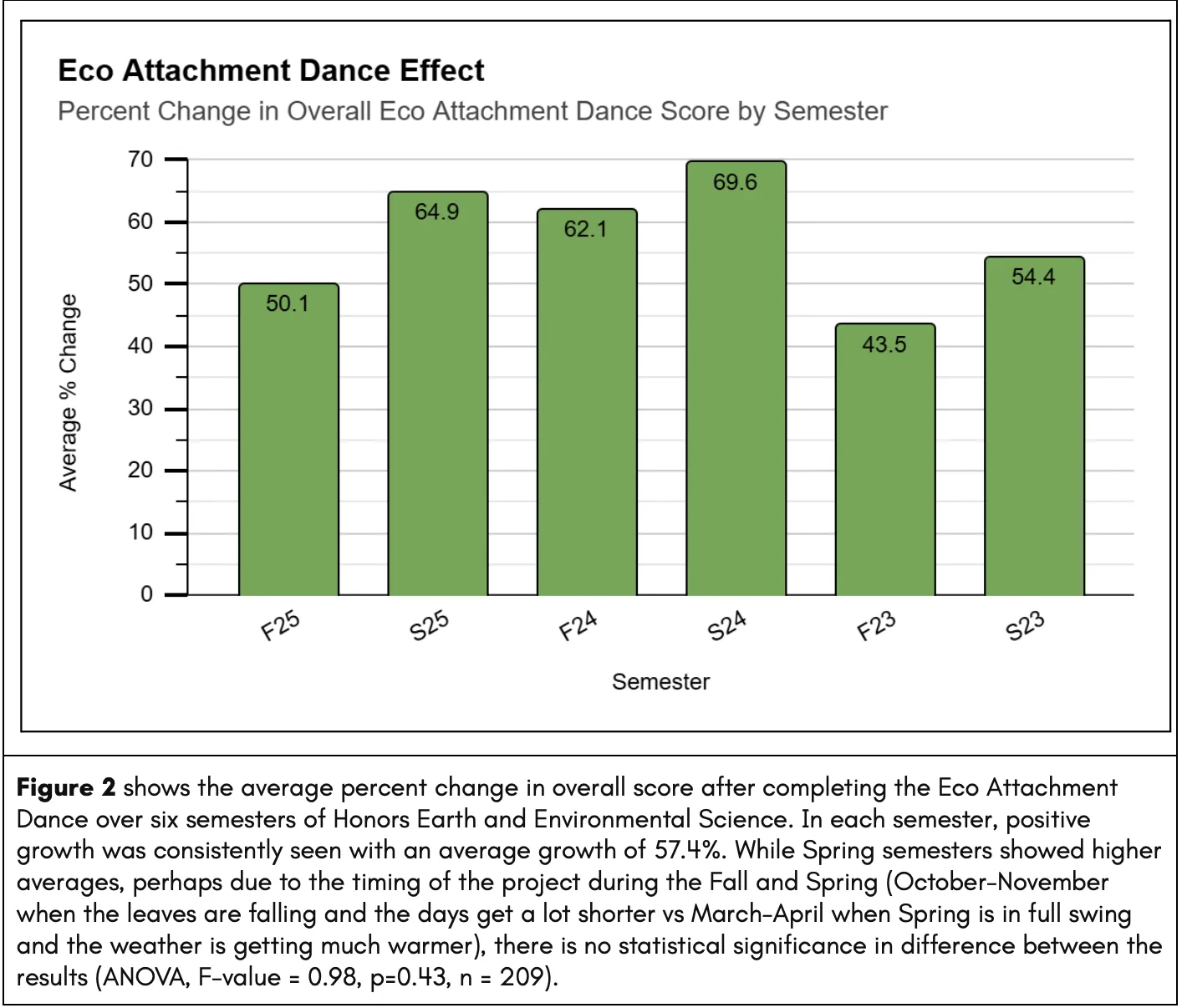
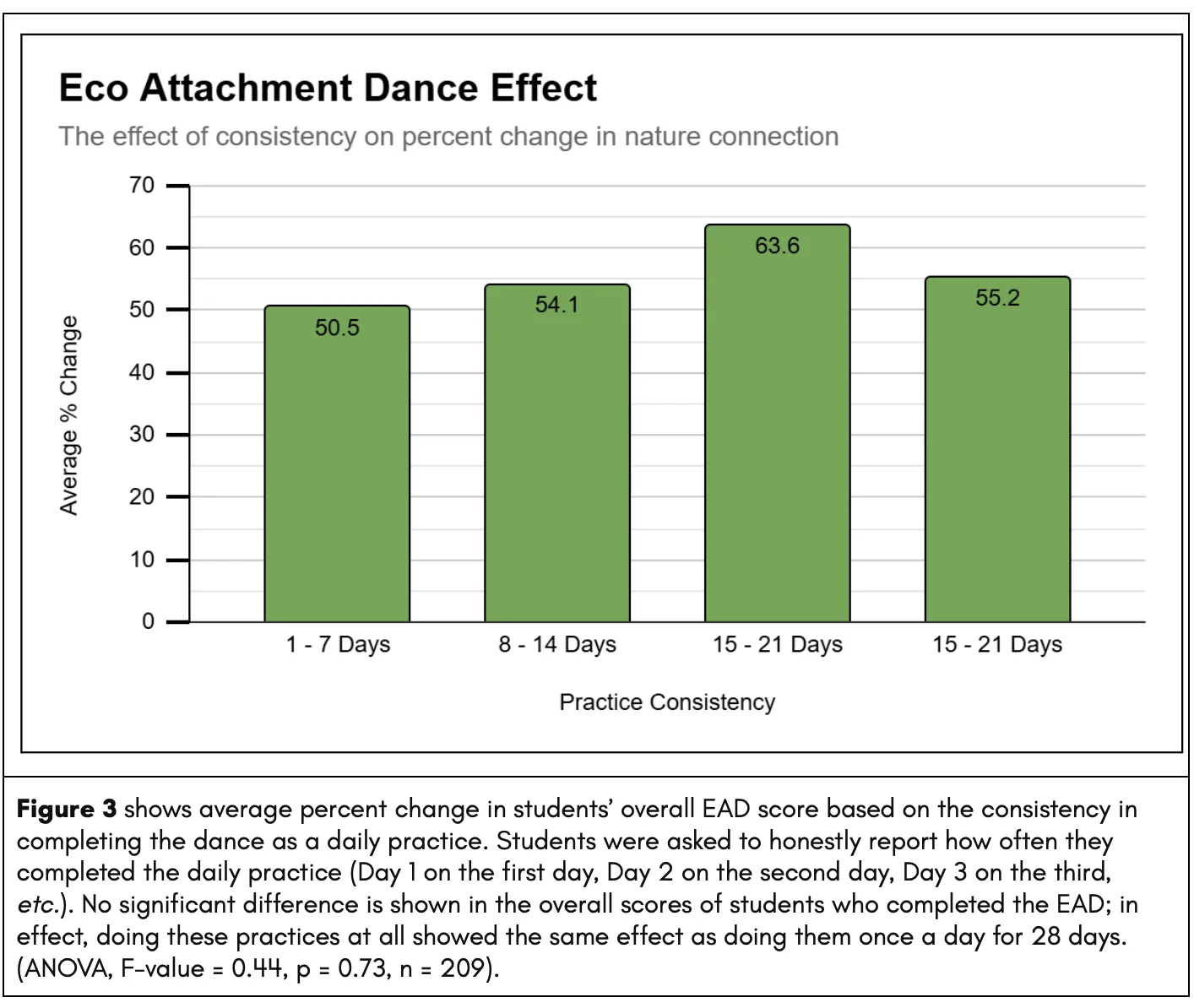
When I speak with my students who are now years out from taking my class, they recall this project fondly, albeit with a little hesitancy. “That was a lot of work” being a consistent refrain. But I also think that the effect of helping my students build a deeper connection with nature holds true. I hope that by having this component of the course, they see that more than just classwork, tests, and lab scores matter, and that they have expanded their thinking of what kinds of knowledge have value in a scientific setting.
The Eco Attachment Dance is in part rooted in principles of indigenous peoples and the value in traditional ecological knowledge (TEK), which is becoming a greater component of scientific understanding (notably, it is a component of the Water Quality event for the 2026 Science Olympiad). As people work to create systems to address climate change, ocean acidification, habitat destruction, species extinctions, pollution, and a litany of other issues that our students will have to face in their lifetimes, I hope that by incorporating more than just western science into the classroom, I am better preparing my students to think widely, to consider different perspectives, and to apply all tools available to address increasingly complex problems.